about the book
ENCYCLOPAEDIA of the GUYANESE AMERINDIANS
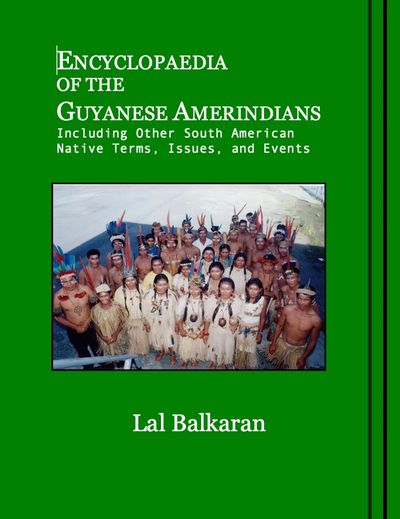
ENCYCLOPAEDIA of the GUYANESE AMERINDIANS: Including Other South American Native Terms, Issues, and Events
This is a new reference on Guyanese Amerindians containing over 7,000 entries, 18 appendices, and 40 photographs. Broad-based and enlightening, and at times entertaining, it covers all nine tribes currently living in Guyana - Ackawaois, Arawaks, Arekunas, Caribs, Makushi, Patamona, Wai Wai, Wapishanas, and Warrau. Amerindians have woven colourful stories to explain a range of notions such as: creation myths; flora and fauna; the forces of nature; other tribes; the environment; origin of strife; and much more. The book contains a fascinating collection of legends, myths, folklore, and other issues and events relating to Amerindians in Guyana. It covers their anthropology, acculturation, belief systems, cosmology, and a host of other subjects. This captivating guide also includes other South American native terms, issues, and events as well.
Find out the story behind Kaieteur, Kanuku, Orinduik, Mashramani, Makunaima, Pakaraima, Roraima, Umana Yana, etc. Learn how Amerindians perceive one another; process food (cassava bread and farine) from the poisonous bitter cassava; make such alcoholic beverages like paiwari, casiri, masato, and parakari; the legend of El Dorado that lured Europeans to Guyana; kanaima (Amerindian bogeyman); the peaiaman (or shaman); the syncretic Alleluia Religion; and much more. Amerindians throughout the Americas are related and have much in common and it is not surprising that the guide contains some issues, events, and terms used by other tribes in other parts of the continent. Words like Amerindian itself, balata, barbecue, buccaneer, cannibal, cassareep, coca, corial, curare, hammock, hurricane, malocca, pegall, pepperpot, quinine, woodskin, and thousands of others are all explained. Indeed, this book is the first A-Z compendium of Guyana’s indigenous people. The book also profiles the following:
- The early explorers and missionaries – Keymis, Gravesande, Schomburgks, Brett, Dorman, Hilhouse, Waterton, Cary-Elwes, MacLintock, Peberdy, McKenna, and others;
- The ranchers – De Rooy, Melvilles, Ogilvie, Hart, and the Rupununi Development Company;
- The various Christian missions;
- Amerindian institutions, events, and programmes;
- Amerindian writers, artists, environmentalists, etc.;
- Early anthropologists – Brett, Im Thurn, and Roth; and
• Amerindian ‘Who’s Who’; – Stephen Campbell, John Bennett, Basil Rodrigues, Guy Marco, George Simon, Stephanie Correia, David Campbell, Jean La Rose, and others.
TABLE OF CONTENTS
Introduction Acknowledgements A-Z Entries
APPENDICES:
A. Map of Guyana
B. Map Showing Distribution of Nine Tribes
C.Map With Distribution of Some Extinct Tribes
D.Timelines of Amerindian Related Events
E. Sources of Information
F. People Lost in Time – Extinct Tribes
G. South American Tribes
H.Central American Tribes
I. North American Tribes
J. Sample Words from Amerindian Languages
K. The Lord’s Prayer in Arawak
L. Amerindian Villages
M. Amerindian Communities, Location, Population, and Predominant Tribe(s)
N. Commanders, Directors-General, Lieutenant-Governors, Governors, Governors-General, Chief Minister, Premiers, Prime Ministers, and Presidents from 1600-2006
O. Roman Catholic Priests who worked among the Amerindians
P. Anglican Priests who worked among the Amerindians
Q. Amerindian Anglican Priests
R. Amerindian Legislators: 1957-2006
Scenes from Guyanese Amerindian Life (40 photographs covering all nine tribes)
Sample Entries: Alleluia (Hallelujah, Areruya Indians)
An Amerindian religion that started in the 1870s blending their animistic belief systems with elements of Christianity. This syncretic mixture resembles, to some extent, Macumba of Brazil and Santería of Cuba, both these sects fusing elements of Christianity with West African beliefs. Alleluia is now known as the Areruya Church and is an affiliate of the Guyana Council of Churches. Its Christian doctrines were undoubtedly obtained from the early missionaries, most likely the London Missionary Society. The religion was started by a Macushi named Pichiwöng (Pisiwöng, Bichiwöng) who lived near the Kanuku mountains in the 1870s. He claimed he had dreams, conversations and an audience with God who asked him to start the religion. Later in the 1880s, the religious practice spread to the Akawaio, Patamona and Arekuna tribes...
Babracot
The babracot is a kind of wooden grill. Used by Indians throughout South America, it consists of a small stage of green sticks built some two feet above an open fire. It is usually supported by three legs in the shape of a pyramid or on four legs shaped like a rectangle while meat is placed on top and smoked. Though losing its flavour, the meat is kept good for many days. Early Spanish settlers observed Taino Indians (a sub-branch of the Arawaks) from Hispaniola (now Haiti and Dominican Republic) using a similar wooden grill they called barbacoa, a term which the Spanish quickly borrowed and corrupted into ‘barbecue’.
Etauchingpang
An Arekuna word meaning ‘we celebrate’. It was a 2-day Amerindian culture gathering that made its debut in August 2001 at the National Park in Georgetown. Coordinated by the Amerindian Peoples Association (APA), it was designed to bring together all nine Amerindian nations from across the country. The gathering was a huge success and almost 5,000 people attended. One of its aims was to mark the tenth anniversary of the APA